Tuesday, June 3, 2008

Don't Stomp the Sculpture


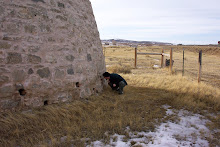
Amasa and I wandered past this spare, abstract sculpture the other day. It sits in front of what I think is a bank, on Hennepin, near the river. I don't know what its intended to represent, or who made it. At any rate, it is apparently highly prized by the bank authorities. Amasa and I were ordered away from the sculpture by security guards. They may have been at least a little justified in doing so - the picture here reveals Amasa attempting to kick it to pieces. The guards also informed me that I can't take photos of the sculpture. So, here are some images, in direct disregard of the sculpture-viewing rules. I must confess that I find the photo ban puzzling. What harm is it intended to prevent? It seems to put the artwork in a weird limbo. Does the transfer of the artwork onto a secondary medium change its status? And if so, shouldn't we be allowed to touch it (as long as its not kicked to pieces)? For a four year old, this is the most primal and intense way to enjoy something - climbing all over it. But if we can't enjoy it as an "image" or as a jungle gym, just how should we enjoy it? As a holy relic? I was reminded of those religious rules against depicting the sublime. Does the artist want it so protected? Perhaps. But if so, that's too bad. Amasa probably had more fun with this thing than anyone has for years, at least until the guards chased us off.


Thursday, May 22, 2008

Tikis in the Urban Jungle


Here's some nice found statuary. This gruesome visage temporarily haunted a yard on Garfield, between 32nd and 33rd. As I was taking this picture, the owner came out her door and told me I could have it! With deep regret, I had to turn her down - I live in a small apartment, and a royal fellow like this needs room to roam. The owner explained that she was having tiki wars with her neighbors, occasionally sneaking this eight foot giant closer to their door. The neighbor heard our conversation, however, and yelled a retort from his porch. The giant remained silent, in stoic nobility.
He's no longer in front of the house on Garfield. I like to think that the owner snuck him into someone else's yard in the dead of night.


Sidewalk Art


Hey, wet cement! Let's write something!


What do you think, wasted opportunity or brilliant social commentary?

I found this gem on the corner of Lyndale and 31st. You know, it isn't really all that often that we come across wet cement. Is it really a good use of a canvas? Maybe some off-hand juvenile sniggering is what the city really needs. The appeal of writing in cement is longevity - Ozymandias employed a stone pedastel for his famous warning to travellers, "Look on my Works, ye Mighty, and despair!". Now it's just, "LICK NUTS".

Sunday, May 4, 2008

A Fellow of Infinite Jest


"a fellow of infinite jest, of most excellent fancy: he hath borne me on his back a thousand times... Where be your gibes now, your gambols? Your songs? Your flashes of merriment that were wont to set the table on a roar? Not one now to mock your own grinning?"

This is The Happy Chef, on the north side of Mankato, Minnesota, next to highway 169. When I lived nearby, about ten years ago, visitors could push a button on the base of the statue, and it would tell some really bad jokes. All I can remember now is something along the lines of "Why isn't there any ice left in your glass at the end of the meal? Because your water gets hungry and eats the ice!" The button doesn't work any more, which is too bad. There were quite a few Happy Chefs throughout the midwest at one time, but this is apparently the last Happy Chef restaurant to still have a statue. I believe the Mankato location was also the original one, also.

Sunday, April 27, 2008

Size Matters: Rodin on the Plains

Did you realize that The Thinker is actually quite tiny? He’s about the size of a garden gnome, but lots less jolly. I recently traveled to see an exhibition of the works of Auguste Rodin at the Hillstrom Museum of Art in St Peter, Minnesota. The Thinker was in attendance, as well as thirty or so other of Rodin’s finest. I was struck immediately by his size. I had been given the impression that he’s a rather larger fellow, and in retrospect I wonder if my mental image had been unduly corrupted by The Thinker’s appropriation by Jesse Ventura’s gubernatorial campaign. It was immediately clear that Le Penseur, as Rodin referred to him, was not sculpted with the WWF in mind.

I’m a little embarrassed to say this, but the size had me a little disappointed, at least at first. And I’m sure that my trip to the exhibition only dramatized the contrast. I drove over an hour through the prairies of southern Minnesota: wide open spaces under a not-quite-endless-sky, hurtling past all that American bigness. Leaving behind the mini malls and office parks of the southern suburbs, the space gives way to orchards and car dealerships, train yards and fields, and, finally, not much of anything. Perhaps the journey altered my expectations – we actually drove under the shadow of an enormous Jolly Green Giant billboard cutout just outside of Le Sueur. So, walking into the museum I was really caught quite off guard.

There are actually several larger versions of The Thinker, made at various times after the appearance of the original plaster cast in 1880.[i] I was quickly made aware that The Thinker’s continued life in the popular vernacular has outgrown his scale. The image is re-invented so frequently that that it was striking to realize that’s its myth originated in such a tiny, singular, and seemingly delicate form.

I was even more surprised to find that I wasn’t looking at the original Thinker at all. Apparently there are complicated rules governing the reproduction of Rodin’s works – if I understand things correctly (which I may not), up to twelve casts can be reproduced from the original, at any point in time. So, even though Rodin died quite a few years ago, casts can still be made up until the magic number. Any reproductions beyond a dozen, however, fail to be authentic. I really think this seems a little odd. Why twelve? And wouldn’t size matter? The original Thinker is apparently 182.5 cm in height, which means that the one I saw in St Peter matched up pretty closely. But its size has nothing to do with its authenticity, which is guaranteed instead by the numerical order of its production – some of the large Thinkers are also authentic, but are closer to 2 meters in height.

Does this leave anyone else confused? The calculus of Rodin reproduction can get pretty complicated pretty quickly, and I’m not sure what it’s all indicative of anyway. At any rate, I wondered at the significance of this little thing I was looking at. Why had I traveled all this way to just to see this tiny reproduction? It wasn’t even original (but it was, perhaps, authentic, if you can keep up with the math). And would it really have been more impressive to see the original anyway? Would I have been able to tell the difference?

In telling a friend of mine that I had been to see The Thinker, he suggested that sculpture-watching was perhaps not all that compelling a sport anyway. I could mark it off my checklist, but what could it offer beyond that? Actually, though, I did find more in the sculpture than I anticipated would be there. The subject of The Thinker is not just a man lost in thought, caught in a quiet moment of distraction. He’s considering very serious matters indeed. The piece was intended to be a small component of a monumental portal to the Musee des Arts Decoratifs in Paris. Rodin titled the work The Gates of Hell - and the thinking subject was originally intended to be Dante himself, considering his great poem (though in its final form The Thinker was not intended to have a specific identity). In the portal, The Thinker’s gaze doesn’t seem to be focused anywhere, except perhaps inwardly. This is indeed striking, because as he averts his eyes, immediately in front of him, a man falls hopelessly into Hell.

The image of The Thinker is often understood to be an immediately recognizable representation intellectual activity, but a close look at the sculpture reveals that this misses the point. The Thinker sits in such a terribly awkward pose – his elbow is on the wrong knee for instance – that its clear that his mental dilemma leaves him physically distraught. Surely, Ventura didn’t wish to project the image of a man thinking about the fires of damnation (but would it have changed your vote if he did?).

The Thinker sits precariously. His brief life is nigh at and end, and he well knows it. With that in mind, the tiny sculpture I saw at the Hillstrom somehow seemed more significant. What was this tiny lump of lead and bronze I was looking at? Was it really a work by the hand of Rodin? No, it wasn’t. And so it seemed all the more unlikely that this tiny figure should yet persist, encased in glass, attracting the curious from across rural southern Minnesota. Its delicateness seemed to signal all the more its unlikelihood. It managed to stave off its own oblivion, for at least a little while, and I was surprised to find that it somehow made me feel a little more cheery, wondering at this Rodin, that was hardly a Rodin at all.

[i] For a great discussion of the various casts see http://www.penseur.org/

Monday, April 21, 2008

Art as Hoax, Hoax as Art: A commentary on Aliza Shvarts and the meaning of art

Living as late in the day as we do, it is readily accepted that definitions of art have burst past the point of recognition. Most can admit that we no longer need an art “object” as a locus for discussion. “Art” may take many forms. Nevertheless, inasmuch as art can be discussed at all, one must ask what the boundaries of “art” are (even if those boundaries may not exist). The recent fiasco surrounding Yale art major Aliza Shvarts’ senior project, which involved the intentional and repeated inducement of miscarriages over a nine month period, raises such questions.


After the story broke on April 17th, it was quickly debunked as a hoax by Yale’s administrating authorities. Lest we turn away too soon, however, Shvarts quickly retorted that it wasn’t really a hoax after all, and that she had just told Yale officials what they had wanted to hear.[1] Although we may tend to believe whatever we find most settling about the whole affair, the actual truth is at least a little bit obscured. And this ambiguity, of course, is precisely the point of the whole exercise.


If we take the story as truth (which we certainly don’t need to do), then it still leaves unresolved questions about the status of a “work” of art. I certainly don’t mean to resolve any of these questions here but these questions are still pertinent to a discussion of the status of art, or the reports of its demise.[2]


While the “art” did consist of some physical material – a documentation consisting of blood, Vaseline and film – it seems that the documentation is almost irrelevant. The material display doesn’t really add anything to the central provocative claim. The real power of the exercise is that someone would induce abortion for art’s sake. If I’m correct in seeing the art in this way, then we’re left wondering what art is: can art be simply a claim, a declaration? If Schvarts had simply turned in her declaration of intentionally induced miscarriage, would she still get a passing grade (and what grade is she getting anyway)? Obviously, performance art doesn’t rely on physical material for its status as art, but its hard to see this as performance, either. The behaviors in question were not “performed” in any traditional sense, because they lacked an audience (we might judge the art as a work of film, but it seems, again, that any power the project conveys is not tied to its status as film at all). Can art be reduced to a provocative statement, which is almost (though not entirely) absent an element of craft?


If we take the whole affair as hoax, then perhaps the claim to art is a little stronger. We’re all familiar with the suggestion that art is a lie that tells the truth. But how important is truthfulness to the equation? If it is a hoax, then we have art as lie – but only that.


If its not a hoax, then it is art as the report of strange behavior. And we can here think of various comparable behaviors. Might I claim to my students that being drunk while lecturing is an important aesthetic experience for them? Shall they counter that a state of deep existential depression precluding an ability to turn in a final paper is an appropriate culmination to an introduction to philosophy course? Can one simply do something strange, dangerous, or immoral, and then tell people that it was art. Is that enough? If this is our guideline, there are a lot of behaviors that qualify, but that we would never ordinarily think of as art. And what does odd behavior have in common with, for instance, Gainsborough’s Blue Boy, such that they would both fall under the category “art”? Do we perhaps need a new name? Is it important that we make these distinctions at all?


As a hoax, the events have a stronger claim. And as Schvarts has made clear in her own statements, the art is about (inasmuch as a set of behaviors can be “about” anything) the resultant ambiguity: we don’t know if the blood is the result of normal menstrual cycle, or an aborted fertilized egg, or animal blood she hurriedly gathered together the night before the project was due. Throughout all of this, we’re still left with something troubling: art as ambiguous publicity stunt.


Even if everyone is famous for fifteen minutes, it doesn’t necessarily follow that each of those fifteen minutes is a work of art. Does art happen whenever the public is briefly shocked, confused, or amused (and could we then submit Larry Craig’s behavior in an airport bathroom as art)? Or, perhaps, only when the public is shocked and confused by something which turns out not to have been true? I fear there’s a central confusion here. We know that art can be shocking. Picasso’s Guernica is proof of that. But that doesn’t mean that art resides in the shock. Guernica was also a painting. Absent the painting, what is left that we can identify, and do we need to identify a “work” of art anyway?


I am certainly not in any position to resolve any of these questions, and so, for the time being, I’ll leave it all open for discussion. Bringing up a lot of irresolvable questions – that can be my “art”.


[1] Schvarts’ explanation: http://www.yaledailynews.com/articles/view/24559
[2] Here’s a link to the original story: http://www.yaledailynews.com/articles/view/24513

Saturday, April 12, 2008

The Gehry in the Machine

I recently attended a lecture at the Minneapolis Public Library concerning Frank Gehry’s design methodology, and it sparked some questions for me concerning architectural models, paradigms, and the primacy of artistic creation. The lecture detailed the shift in Frank Gehry’s approach to construction, since discovering the architectural potential of some computer software originally designed with aerospace engineering in mind. I’ll oversimplify things here for the sake of brevity and argument, but hopefully some questions will begin to make sense. Gehry’s design process famously relies on transposing from very abstract models. Because the models are so geometrically irregular, the transposition has been extraordinarily complicated. This may have been most particularly the case with the Weisman Museum at the University of Minnesota. As it was suggested at the lecture, the Weisman was in some sense the last of hand drawn buildings. Beginning with the Guggenheim Bilbao, and more explicitly with the Experience Music Project in Seattle, Gehry and his firm realized that they could utilize new software to translate all the abstraction into hard numbers. This made the whole process tremendously more efficient, saving huge amounts of time and money. After the Weisman, the traditional paper and pencil were no longer necessary – the abstract model could be scanned directly into a virtual representation of itself, complete with the necessary numbers. So, the argument in favor of the process might go something like this: the EMP is much more structurally complicated than the Weisman, but was realized more efficiently. Leaving behind the pencil and paper provides two important benefits: a more complicated design and a cheaper price tag.

But, is it fair to ask whether any downside accompanies these benefits? My question concerns the aesthetic differences that accompany the gradual shift toward greater control. The EMP has a very different aesthetic appeal (while at the same time being very clearly a work by Gehry). It looks much more sleek, more refined, more “produced” (and, indeed, it is all of these things). With the Weisman, it is much more evident that there is a gap between the abstract model and its transposition into a built structure (though, this gap might be something desirable). The geometries are more rigid (more straight lines, less, swooping and diving curves, for instance). An analogy was made with the master builders of the Medieval cathedrals. The tradition of the master builder is one of (not quite) complete control – overseeing all facets of the building process, controlling the transition from the drawing room floor to the built walls. Gehry’s new process brings him closer to the tradition of the master builder. With the Weisman, a tremendous amount of work was left to contractors, out of a matter of necessity due to the complexity of the designs. The virtualization of the design process returns control, both to the architect and, just as importantly, to the model itself.

But does the greater control of the construction process lead to an aesthetically preferable result? To put it bluntly, is it worth it? It would be too much to characterize it as a Faustian bargain, but nevertheless, one might ask whether the greater increase of efficiency leaves something to be desired. One of the more celebrated and appealing characteristics of Medieval cathedrals is their indeterminacies – those architectural moments which fall outside of the master builder’s plan – stonemason’s signatures, unique gargoyles, and other irregularities. What do we look for in a complete building – a direct translation form a model, or perhaps an indirect one.

How closely should a work of architecture resemble its paradigm? To the extent that a work becomes a more repeatable duplicate of its model, then we might look at the building itself as a “duplicate’, a copy. In just this sense I’ve used the word transpose to refer to the process of proceeding from the model to the building. But a transposition, of course, means that two things shift places. Is there not normally a shift in primacy from the model to the building, once construction is complete? If for Gehry, the primary work is the model, then by all means it makes sense to try to duplicate that model as precisely as possible. But then what can we say about the building? Is it secondary to the model (and we might here be reminded of the trend of museums paying millions for architects’ collections of renderings, models, and other artifacts once thought to be mere secondary ephemera).

In other forms of art, we ridicule anything judged to be over-produced. Britney Spears, Justin Timberlake, and Ashley Simpson are just a few of the obvious musical examples. Lucas basically ruined his Star Wars franchise with an overreliance on CGI, i.e. Jar-Jar Binks. Likewise, we might scoff at Thomas Kincade’s art empire or even a fast food meal for not just being generally bad, but for being produced too closely to a formula. I admit that I’m being at least a little unfair here – any of Gehry’s works are of far greater aesthetic significance than a McDonald’s burger, and I don’t mean to put the two on the same level. Frankly, Seattle’s EMP really is pretty cool, even if something was lost in the transposition. But we might still ask about the virtue of live performance, even in architecture.